
Gait problems, falls, incontinence, memory trouble: in an older adult, these symptoms point in many directions at once. Normal pressure hydrocephalus (NPH) is one of the few on that list whose symptoms can be improved.
The challenge is that NPH is, at its core, a disorder of fluid flow, not of resting pressure. A test that measures how the CSF system behaves under load is what turns clinical suspicion into a physiological answer.
Why “Normal Pressure” Hydrocephalus Is a Flow Problem
The ventricles enlarge, yet CSF pressure measured at lumbar puncture sits within the normal range. In their 2025 review in the Journal of Neurosurgical Sciences, led by X-Pressure co-founder Eric Schmidt, and Joachim Krauss, resolve that paradox by reframing iNPH as a disturbance of cerebral hydrodynamics, with high resistance to CSF outflow as one of its most consistent findings.
Behind that framing is Darcy’s law, the principle that describes how fluid moves through a porous medium. Flow depends on two things: the pressure driving the fluid and the permeability of the material it passes through. In the brain, CSF is produced continuously, mostly by the choroid plexus, at around 0.3–0.4 mL/min and drains through a porous network of outflow routes: arachnoid granulations, meningeal lymphatics, and glymphatic and perivascular pathways.
- When those routes are permeable, CSF drains as fast as it is produced. Ventricles stay normal in size, and baseline pressure stays normal.
- When those routes become less permeable, the same production rate meets more resistance. Fluid accumulates slowly and the ventricles dilate, but baseline pressure can still read as normal.
This is the core diagnostic problem: at rest, a healthy system and a resistive one can look the same on a pressure reading. The difference only becomes visible when the system is asked to clear more fluid than usual.
Applying a Controlled Fluid Challenge: How the Infusion Test Works
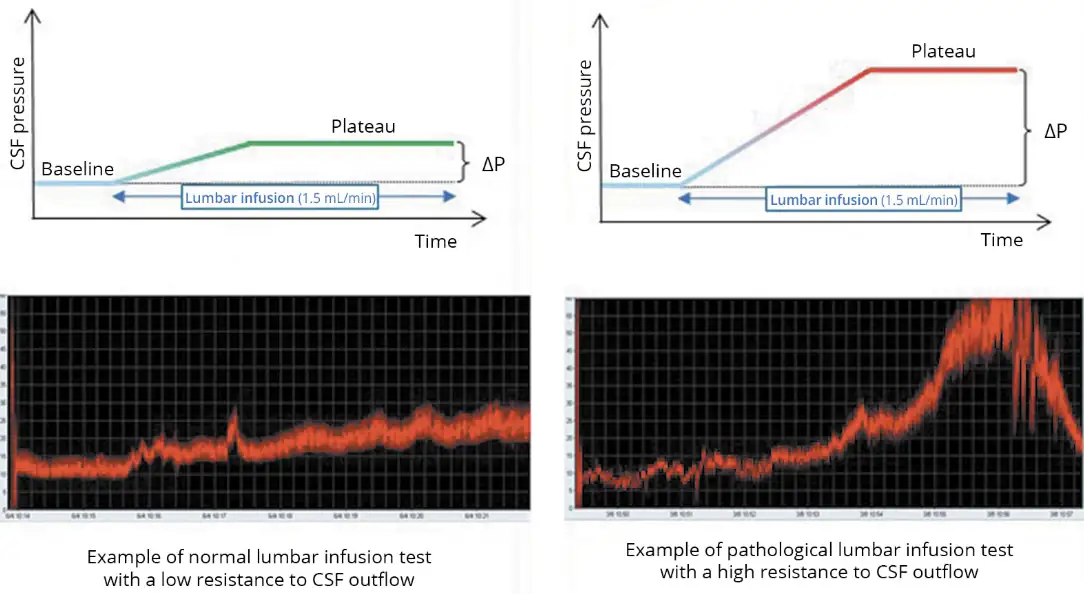
The lumbar infusion test asks exactly that question. Through a lumbar puncture, fluid is infused into the subarachnoid space at a constant rate (commonly 1.5 mL/min, roughly four to five times the brain’s own production rate) while CSF pressure is recorded continuously. Pressure rises from baseline until outflow catches up with the added load, then levels off at a plateau.
The height of that rise is the readout. Dividing the pressure increase (ΔP) by the infusion rate gives the resistance to CSF outflow (Rout), a functional measure of how permeable the outflow pathways are. We covered the formula and its validation history in detail in our earlier post on Rout; here, the two cases illustrated in the Schmidt and Krauss review show what the numbers look like in practice:
- Normal hydrodynamics: the infused fluid drains effectively and the plateau settles close to baseline. Rout ≈ 8.6 mmHg/mL/min, which at 1.5 mL/min corresponds to a rise of about 13 mmHg.
- Altered hydrodynamics: with reduced tissue permeability, the same fluid load produces a much higher plateau. Rout ≈ 26.6 mmHg/mL/min, a rise of about 40 mmHg.
Same procedure, same infusion rate, a threefold difference in resistance. For context, values above roughly 12 mmHg/mL/min are the threshold most commonly associated with shunt response, following the Dutch NPH Study. In the second case, a shunt restores flow by bypassing the resistive tissue altogether.
The procedure is well tolerated. The UK’s National Institute for Health and Care Excellence (NICE) concluded that current evidence on the lumbar infusion test raises no major safety concerns, and a Danish series found that it can be performed in an outpatient setting, with the shunt decision made from the lumbar test alone in 80% of iNPH patients.
iNPH Rarely Travels Alone
If iNPH presented in isolation, symptoms and imaging might be enough. In practice, the literature consistently shows a high prevalence of coexisting neurological disorders, including cerebrovascular disease, Alzheimer’s disease, and Parkinson’s disease or other parkinsonian syndromes.
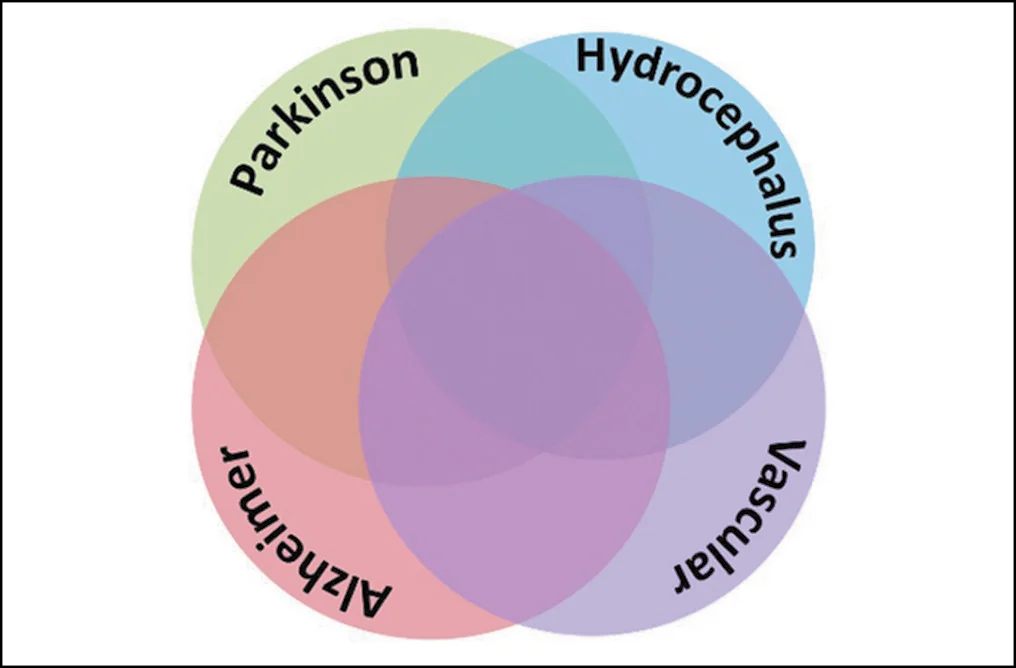
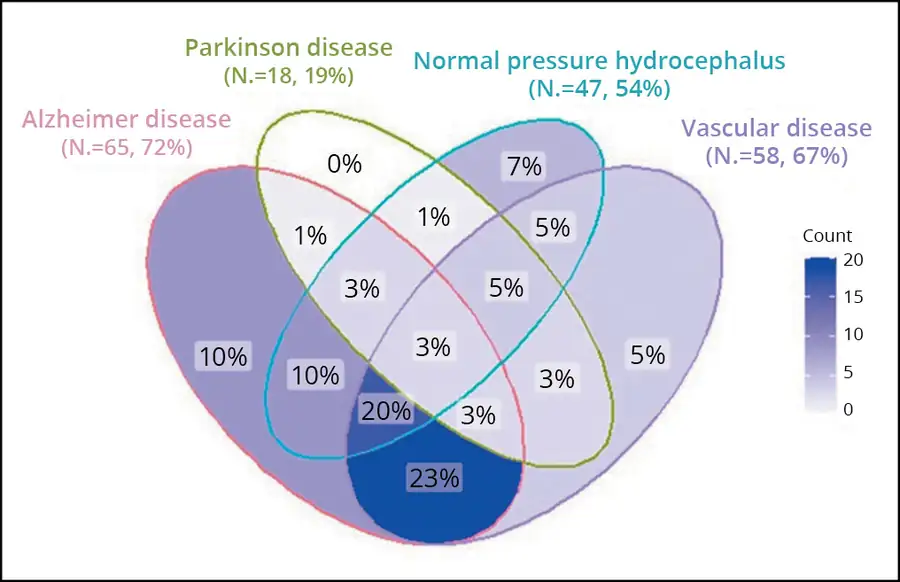
The PROLIPHYC cohort at Toulouse University Hospital (Guillotin et al., Aging Cell, 2024), led by Dr. Schmidt, illustrates just how extensive that overlap is. The study combined clinical and neuropsychological evaluation, gait analysis, MRI, lumbar CSF dynamics, and CSF proteomics in patients suspected of NPH or related neurodegenerative disease. As summarized in the Schmidt and Krauss review, profiles consistent with:
- Alzheimer’s disease were found in 72% of patients
- Vascular disease in 67%
- Normal pressure hydrocephalus in 54%
- Parkinson’s disease in 19%
Those figures add up to far more than 100% because most patients fit more than one profile at once.
This changes the clinical question. As one biopsy-correlated study put it, the issue facing the clinician is less whether a patient has iNPH or another disorder, and more which condition is the major contributor to the symptoms. Comorbidity alone should not close the door: a 2022 study of “Complex NPH” found no significant difference on comorbidity scales between responders and non-responders to CSF diversion.
Imaging and symptom checklists struggle to untangle overlapping diseases. A functional measurement of CSF dynamics answers a narrower, more useful question: is there a hydrodynamic component here that a shunt can treat? Unlike neurodegenerative diseases that remain incurable, that component can be reversed.
Tap Test, Lumbar Drain, or Infusion Test?
Three supplementary tests are used to predict who will respond to a shunt. Two of them, the tap test and external lumbar drainage (ELD), remove CSF and watch for clinical improvement. The infusion test is the only one that measures the hydrodynamic mechanism directly.
Each test has a role. The tap test’s low sensitivity means a negative result cannot rule iNPH out. In a direct comparison of 68 patients, Kahlon et al. found that 84% of patients who improved after surgery had been identified by a positive infusion test, compared with only 42% by a positive tap test. False negatives among operated patients ran at 58% for the tap test versus 16% for the infusion test.
Extended drainage performs well, but at a cost: days in hospital, and in a series of 233 patients, significant complications in 3%, including hemorrhage and meningitis.
No test is perfect in both directions. The European iNPH Multicentre Study found positive predictive values above 90% for both Rout and the tap test, but negative predictive values below 20%. These tests are best at selecting patients for surgery, not at excluding them, which is why Schmidt and Krauss argue for continuing to study iNPH as a disorder of cerebral hydrodynamics as a whole.
The infusion test’s advantage is that it combines high sensitivity with the practicality of a single outpatient procedure, and it produces an objective number rather than a judgment of symptom change.
The Bottom Line: Measure the Mechanism
NPH earns its name because resting pressure looks normal. That is precisely why resting measurements, imaging, and symptom checklists so often leave clinicians uncertain, especially in older patients who carry several diagnoses at once.
The lumbar infusion test addresses the problem at its source. It applies a controlled fluid challenge, measures how the CSF system responds, and expresses the answer as a single, interpretable value. It is the test built on the physics of the disease itself: if outflow is resistive, the infusion test sees it.
And because iNPH is treatable, getting that answer matters. The PENS Trial confirmed that shunting works for well-selected patients. The task now is making sure that selection, grounded in CSF dynamics, is available to every patient who needs it.
Interested in how XP One will bring standardized measurement during CSF infusion testing to the bedside? Visit our solutions page or reach out at contact@x-pressure.com.