
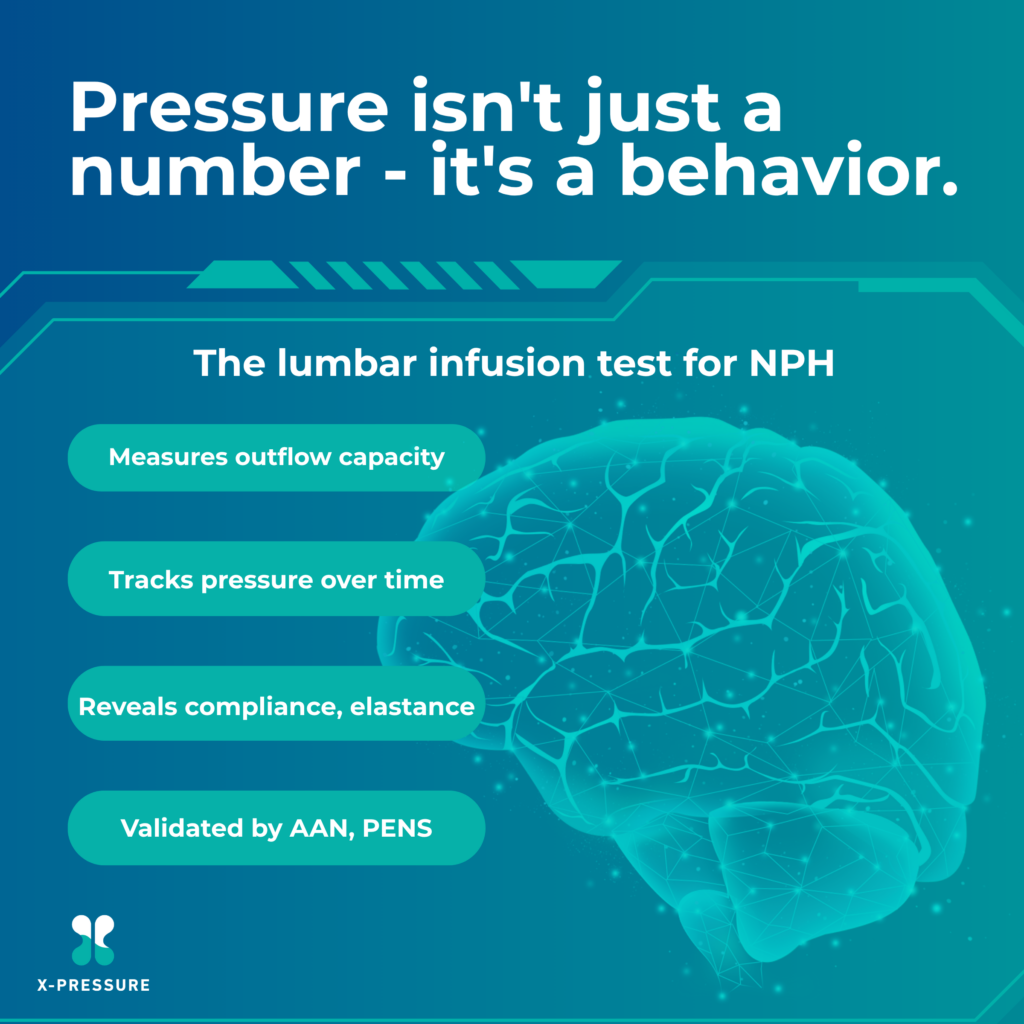
While neuroimaging readily identifies ventriculomegaly, it cannot definitively show whether a patient with idiopathic normal pressure hydrocephalus (iNPH) will improve after a shunt is placed.
The lumbar infusion test closes this diagnostic gap by producing a highly validated metric – resistance to CSF outflow (Rout) – which remains the most evidence-backed predictor of shunt response in iNPH.
Benefits and Mechanics of Infusion Testing
Idiopathic Normal Pressure Hydrocephalus (iNPH) is difficult to diagnose from imaging and exams alone. Ventriculomegaly overlaps with cerebral atrophy, and the triad of gait disturbance, incontinence, and cognitive decline overlaps with Alzheimer’s, Parkinson’s, and vascular disease. The AAN practice guideline on iNPH addresses this directly: elevated Rout is identified as a predictor of shunt response on the strength of Class I and Class II evidence. The lumbar infusion test is the procedure that produces that measurement.
In a standard lumbar infusion test, a spinal needle is inserted into the subarachnoid space. Fluid, typically saline, is infused at a constant rate while intracranial pressure (ICP) is continuously monitored until it reaches a new steady-state plateau. Using the established Marmarou formulation, Rout is calculated as: (ICP plateau − ICP baseline) / infusion rate.
While this constant-rate method is the most widely used protocol, alternative variants exist, such as bolus-infusion (which produces Marmarou’s original pressure-volume index) or stepped-function protocols that sample pressure at controlled increments. Ultimately, all of these are protocol choices for the same underlying diagnostic test: using a controlled fluid challenge to estimate CSF outflow resistance.
The Evidence Behind Rout as a Predictor
Rout’s prominence in iNPH diagnostics is built on a specific, robust evidence base.
The Dutch NPH Study (Boon et al., 1997) found that elevated Rout predicted shunt response with a positive predictive value as high as 92–100%, and that finding has since been reproduced closely enough across cohorts to anchor the common clinical cutoff of >12 mmHg/mL/min.
Most recently, the PENS Trial – the first large, placebo-controlled trial confirming that shunting works in iNPH – reinforced the same point from a different angle: enrollment required a positive CSF drainage response beforehand, and as we’ve written previously, that pre-selection is a large part of why the trial’s responder rate reached 80%. Rout-based selection is close to the mechanism by which the trial’s results were achievable.
Clinicians should note that Rout performs significantly better as a positive predictor than a negative one. Multiple validation cohorts have demonstrated that its high PPV is paired with a comparatively weak negative predictive value (NPV). Consequently, a low Rout does not reliably rule a patient out for a shunt. In their 2025 review, Schmidt (X-Pressure’s co-founder and Chief Scientific Officer) and Krauss make the case that this is a reason to keep investigating iNPH as a disorder of cerebral hydrodynamics generally – Rout is the best-validated single marker within that framework, not the final word on it.

A Bonus Readout: The P1/P2 Waveform
The same infusion that yields Rout at plateau is also recording a continuous ICP pulse waveform, and that waveform carries additional, if less definitively validated, information. The waveform has three characteristic peaks: P1 (percussion wave, from arterial pulsation transmitted through the CSF), P2 (tidal wave, driven by intracranial blood volume change and dependent on compliance), and P3 (dicrotic wave).
Under normal compliance, the P1 peak dominates P2. However, as intracranial compliance falls, the P2/P1 ratio rises, serving as a rough physiological correlate of elastance.
The Bottom Line on Rout and Shunt Response
Ultimately, Rout’s value lies in what it represents: a functional readout of whether a patient’s CSF outflow pathway can plausibly support the pressure dynamics that shunting is designed to correct. It doesn’t guarantee an outcome – no single measure does – but among the tools available before surgery, it remains the one most consistently tied to who actually improves.
That’s why it anchors the AAN guideline’s recommendation, why a positive CSF drainage response was a precondition for enrollment in the PENS Trial, and why, for now, it’s the number worth trusting most when deciding who to shunt.
Interested in how XP One will bring standardized measurement during lumbar infusion testing to the bedside? Visit our solutions page or reach out at contact@x-pressure.com.